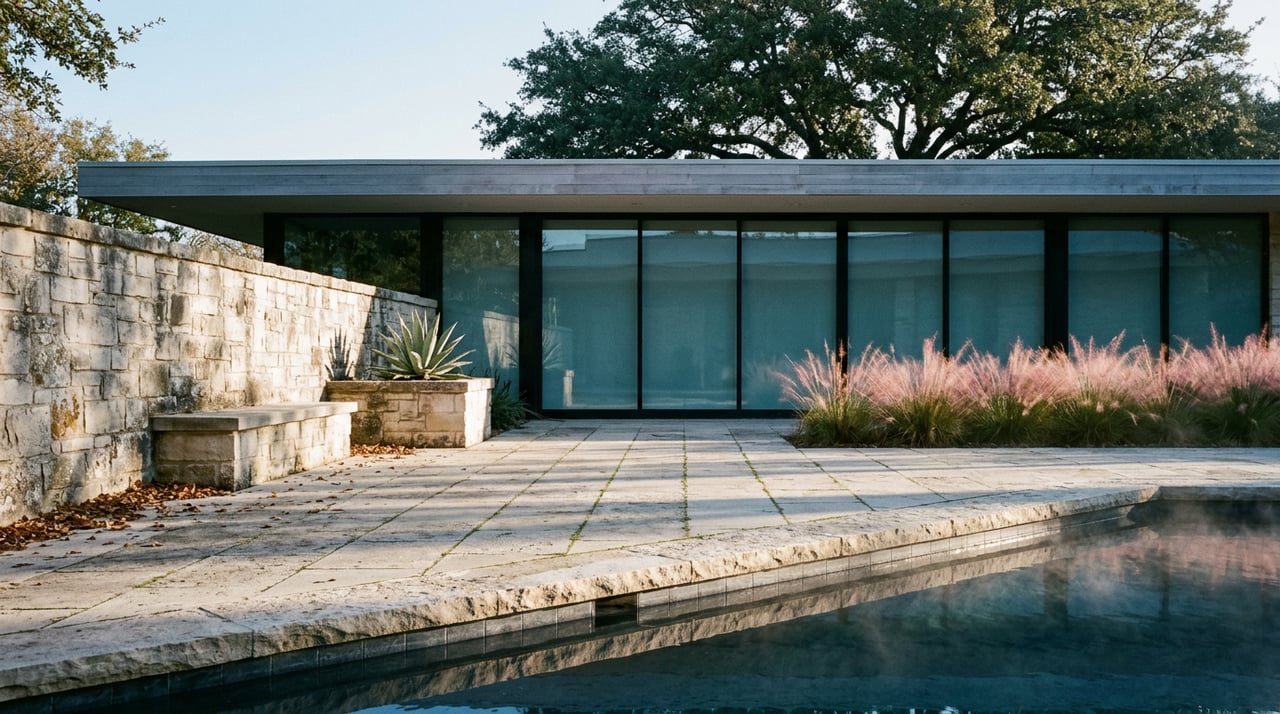
Walk down East Live Oak Street on a cold January morning and you will see something that looks wrong until you understand it. Steam rises off the surface of an outdoor pool while frost sits on the grass around it. Swimmers do laps in short sleeves of water while everyone standing poolside is bundled up. Big Stacy Pool has been doing this since 1937, and most people who live near it in Travis Heights have stopped questioning why. It is just the warm pool. It has always been the warm pool.
That assumption is the thing worth examining, because the mechanism behind it is not what most people think, and it is not permanent.
Not the Same Trick as Barton Springs
Austinites tend to lump Big Stacy in with Barton Springs, another beloved outdoor swimming spot fed by underground water. But the comparison undersells what is actually happening under Big Stacy. Barton Springs holds a constant 70 degrees because it draws directly from the Edwards Aquifer, an underground flow that never stops. Big Stacy works differently. A well drilled 1,600 feet into the ground feeds a pump system that pulls heat up and pushes it into the pool, and that system only switches on when it needs to. Paul Slutes, who manages the City of Austin's Aquatic Division, has explained that the well will not activate during the hottest months because the water is already warm enough on its own. It does not run when the outside air climbs above 80 degrees. In winter, when the switch does flip, the pool holds between 90 and 100 degrees, and roughly 50 swimmers a day show up to use it even in the coldest weeks of the year.
This is not ambient warmth. It is an engineered system with a trigger point, built nearly 90 years ago, and it has a physical limit that Barton Springs does not.
A Well That Cannot Be Fixed the Normal Way
The trouble is that the well itself is wearing out. At one point, the city's aquatic division brought in well specialists to try clearing it using high-frequency sound, a standard maintenance technique. What they found instead was a well casing so fragile that the cleaning process itself risked collapsing the entire structure. The specialists' recommendation afterward was blunt: leave it alone. Repairing it in place is no longer considered an option. Drilling a new well is a possibility the city could pursue, but nothing has been announced.
In response, Austin Parks and Recreation quietly installed backup gas heaters at the pool. They are tested every year and have not yet been switched on for real use. When they are, the pool stops being naturally heated in any meaningful sense. It becomes a gas-heated pool that happens to sit on top of an old well, and Slutes has said the resulting bill could run as high as $10,000 a month during full operation. That is the number that should reframe how residents think about their neighborhood pool. The warm water at Big Stacy is not an inexhaustible feature of the land. It is currently free, both in the sense of admission and in the sense of not costing the city meaningful money to produce, and both of those things are riding on a piece of 1930s infrastructure that engineers have already told the city not to touch.
What the Water Means to the People Who Use It
None of this is abstract for the people who actually swim there. Beverly Deutsch has been going to Big Stacy for years. After a stroke in 2021 left her without function on her right side and without the ability to speak, she started using the pool for physical therapy.
"I use it to do my laps for my ongoing physical therapy recovery from stroke because I had lost my right side function and the ability to speak. You never completely recover, but swimming here helps."
That kind of use is only possible because the pool is warm enough for therapeutic laps in January and because it costs nothing to get in. Admission at Big Stacy is free, which is unusual for a heated municipal pool of any size, six lanes across a 33-yard span, open every day except Mondays and days when the temperature drops below freezing. If the well fails and the backup heaters carry the full load, the city has not indicated plans to change the free admission model. But a facility that currently sustains itself through a geothermal accident of geography is a different civic commitment than one that requires an active, ongoing gas expense to keep running. The people who benefit most from the current arrangement, like Deutsch, are the ones with the most at stake in how the city eventually answers that question.
The pool closes briefly every spring for standard upkeep. This year the closure ran from May 9 through May 17, 2026, while the city handled its annual cleaning and maintenance, a routine, surface-level interruption that has nothing to do with the deeper mechanical issue sitting underneath it.
Why It Matters That the Pool Is Historic, Not Just Old
Big Stacy was built with New Deal money under the Works Progress Administration, and it sits inside a stretch of Travis Heights recognized on the National Register of Historic Places. Sarah Marshall, the historic preservation program coordinator at Austin Parks and Recreation, has noted that the pool and its bathhouses are considered contributing structures to that historic designation, meaning the well's condition is not just a maintenance line item. It is tangled up in how the district itself gets preserved. The pool's name traces back to Gen. William Stacy, a Spanish-American War veteran who also worked as a real estate agent and developed the Travis Heights neighborhood in the first place, a detail that connects the pool directly to the same forces that shaped the streets around it.
That history is part of why residents treat the well's decline as more than a utilities problem. A gas-heated replacement system would keep people swimming in January, but it would sever the one detail that ties the pool to its original construction and to the geology under the neighborhood.
The Loop Around It
The pool is also just one stop on a longer daily circuit for a lot of people in the area. The Blunn Creek Greenbelt trail connects Big Stacy Park to Little Stacy Park to the north, a shaded, mixed concrete and granite path that runs about a mile along East Side Drive before ending near Travis Heights Elementary. Little Stacy has its own wading pool along with tennis courts and open lawn space, so the common route for a lot of Travis Heights residents is a walk or dog loop through the greenbelt that starts or ends with a swim. None of that changes based on what happens to the well. The trail will keep connecting the two parks regardless of whether Big Stacy is drawing its heat from the ground or from a gas line. One half of that daily loop runs on borrowed geology. The other half is just dirt and shade that will be there no matter what the city decides to do next.
The next time the water is warmer than it has any right to be on a cold morning, remember that the warmth is not guaranteed. It is a choice the ground made a long time ago, one the city is currently working to preserve, and one that will not last forever in its current form.
If you are curious about what makes a specific pocket of Austin work the way it does, from the infrastructure under a neighborhood pool to the value of the homes around it, Drew & Co. is always glad to talk through what we know. Contact Us.